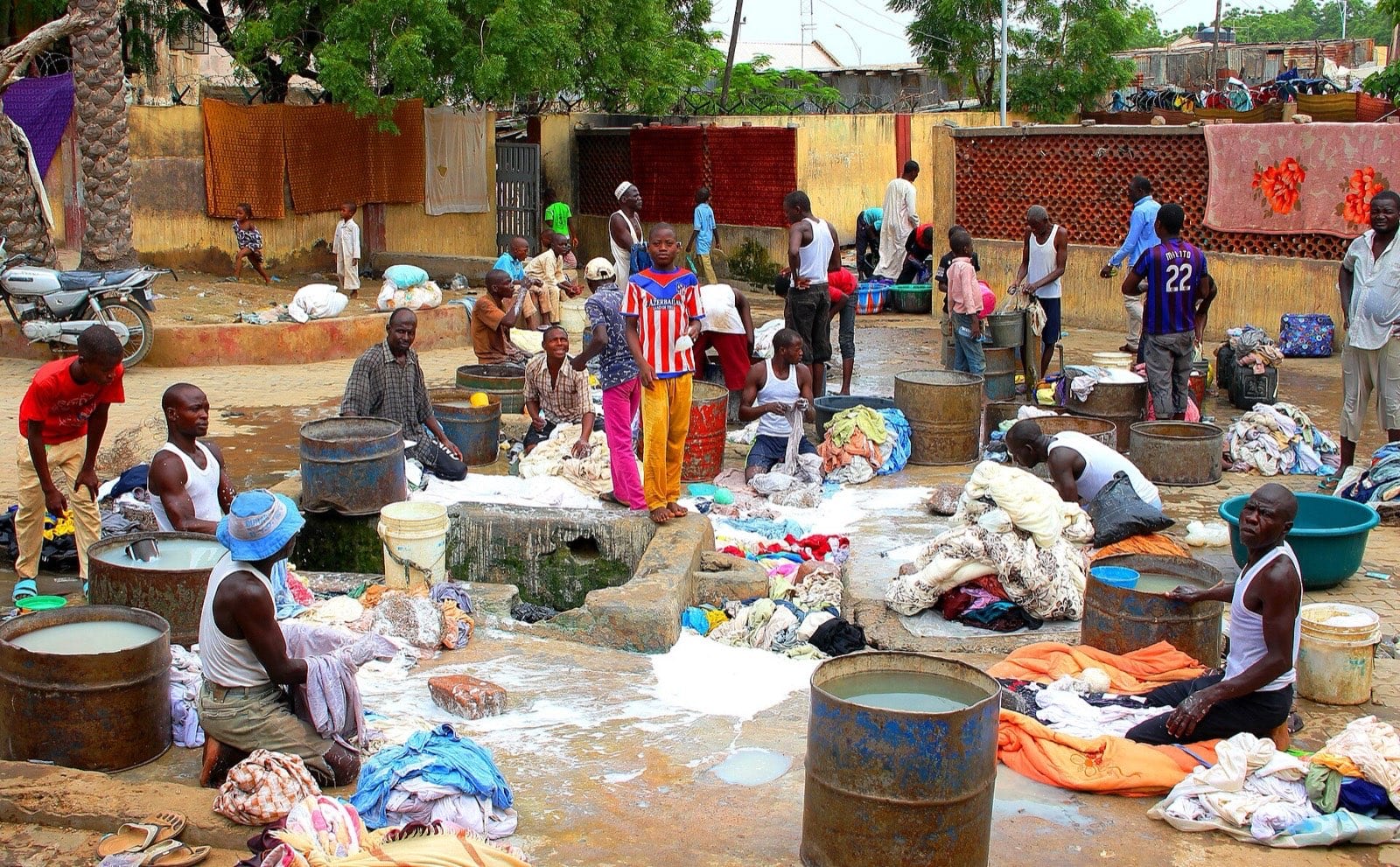
The pits at Kofar Mata are older than almost everything around them. They were sunk in 1498, which is a date the dyers give without hesitation and without much ceremony, the way you might give the year a house was built. Around four hundred of them were still working within living memory. On the morning I visited, Musa Garba counted the ones in use and stopped at thirty-one.
A dye pit is not much to look at: a hole about two metres deep, lined with a mixture of ash and clay, filled with a liquor that is black at the surface and smells faintly of woodsmoke and something sharper underneath. The cloth goes in white and comes out yellow-green. It turns blue in the air, on the walk between the pit and the drying line, which is a piece of chemistry that has been reliably astonishing visitors for five centuries.
What has changed is not the method. It is the arithmetic. A pit takes about three weeks to prepare and will then work for a year or more before it has to be dug out and relined. That labour used to be shared across a guild large enough to absorb it. The men who remain are doing the same work with a fraction of the hands, and they are selling into a market where a metre of printed cotton from a mill costs a fraction of what a dyed cloth costs to make.
What the pit knows
Garba's family have held a place at Kofar Mata for four generations. He is careful to say a place rather than a pit, because the pits themselves are communal and are worked by whoever is entitled to work them. Entitlement is inherited and it is not written down anywhere.
This is the part of the story that resists a tidy ending. There is a version of it in which the craft is saved by tourism, and a version in which it is saved by a designer in Lagos putting Kofar Mata indigo on a runway, and both of those things have happened, at a small scale, more than once. Neither has changed the number of working pits.
“The cloth goes in white and comes out yellow-green. It turns blue on the walk to the drying line.”
Five hundred years, roughly
- The first pits are sunk inside the Kofar Mata gate.
- Kano cloth is traded across the Sahara; the dyeing quarter is among the city's largest employers.
- Imported printed cotton begins to displace dyed cloth in everyday use.
- The number of working pits falls below a hundred for the first time.
- Thirty-one pits in use on the morning of reporting.
What Garba wants is not a museum, and he is direct about that. A museum would preserve the pits and lose the trade. What he describes instead is duller and harder: a guaranteed order, placed annually, large enough that the work of relining the pits is worth doing. Whether anybody places it is not really a question about heritage. It is a question about whether thirty-one holes in the ground in Kano are worth a line in somebody's procurement budget.


.jpg)

